
Determining whether the new crescent moon can be seen after sunset is a question that has fascinated astronomers and moon sighting committees for centuries. Modern astronomy provides several models that help estimate the probability of crescent visibility. Two of the most well-known approaches are the Yallop criterion and the van Gent method.
These models do not replace actual moon sighting, but they help predict whether visibility is possible, difficult, or impossible under normal atmospheric conditions.
Why Crescent Visibility Matters
The beginning of lunar months in the Islamic calendar, including Ramadan and Eid, traditionally depends on the first sighting of the crescent moon (hilal) after sunset.
However, the crescent is often extremely faint and difficult to detect because:
- The moon is very close to the sun.
- The sky is still bright at sunset.
- The crescent is very thin.
- Atmospheric conditions affect visibility.
Astronomical models help determine where on Earth the moon could realistically be seen, allowing observers to know where sightings are likely or unlikely.
The Yallop Crescent Visibility Criterion
The Yallop method, developed by Dr. Bernard Yallop of the Royal Greenwich Observatory in 1997, is one of the most widely used crescent visibility models.
It estimates visibility using a parameter based on:
- The altitude difference between the moon and the sun
- The arc of light (width of the crescent)
- The relative geometry between the sun, moon, and observer
The Yallop criterion divides visibility into six categories:
| Category | Visibility Description |
|---|---|
| A | Easily visible with the naked eye |
| B | Visible with the naked eye under perfect conditions |
| C | May need optical aid but visible |
| D | Visible only with optical aid |
| E | Possibly visible with large telescopes |
| F | Not visible |
Using this classification, astronomers can generate global visibility maps showing where the crescent might be observed.
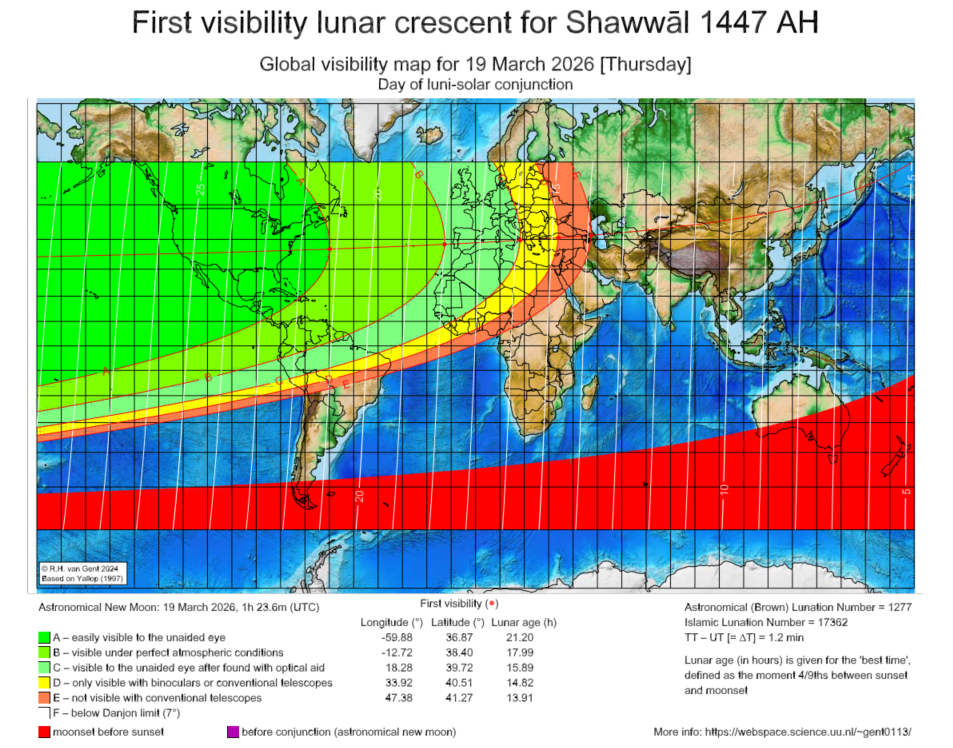
The van Gent Crescent Visibility Method
The van Gent method, developed by Robert H. van Gent, is another scientific approach used to estimate crescent visibility.
This method builds on earlier research (including the Danjon limit) and focuses on geometric relationships between the sun and moon such as:
- Elongation (angular distance between sun and moon)
- Moon altitude at sunset
- Relative illumination of the crescent
Van Gent refined several earlier models and compared historical sighting reports to improve the prediction of when the crescent becomes visible.
His work also highlights the important concept known as the Danjon Limit, which states that:
A crescent moon is generally impossible to see when the elongation from the sun is less than about 7 degrees.
Although some modern observations challenge the strict value of this limit, it remains an important guideline in visibility studies.
How These Methods Are Used Today
Astronomical organizations and moon sighting committees often use these models to:
- Produce crescent visibility maps
- Identify regions where sightings are possible
- Determine where reports are likely incorrect
- Assist observers in planning sighting attempts
These models are widely used by:
- Astronomers
- Islamic moon sighting committees
- Calendar research groups
- Observatories
Important Reminder
Astronomical calculations do not replace actual observation in traditional moon sighting practices. Instead, they help answer key questions such as:
- Is sighting physically possible?
- Where should observers look?
- Are reported sightings plausible?
By combining astronomy with careful observation, communities can make more informed decisions regarding the start of lunar months.
Conclusion
The Yallop and van Gent methods provide powerful scientific tools for understanding crescent visibility. By analyzing the position of the sun and moon, these models help determine when the delicate first crescent might appear in the evening sky.
While the final confirmation often comes from human observers, these astronomical techniques help guide and support moon sighting efforts around the world.
Leave a Reply